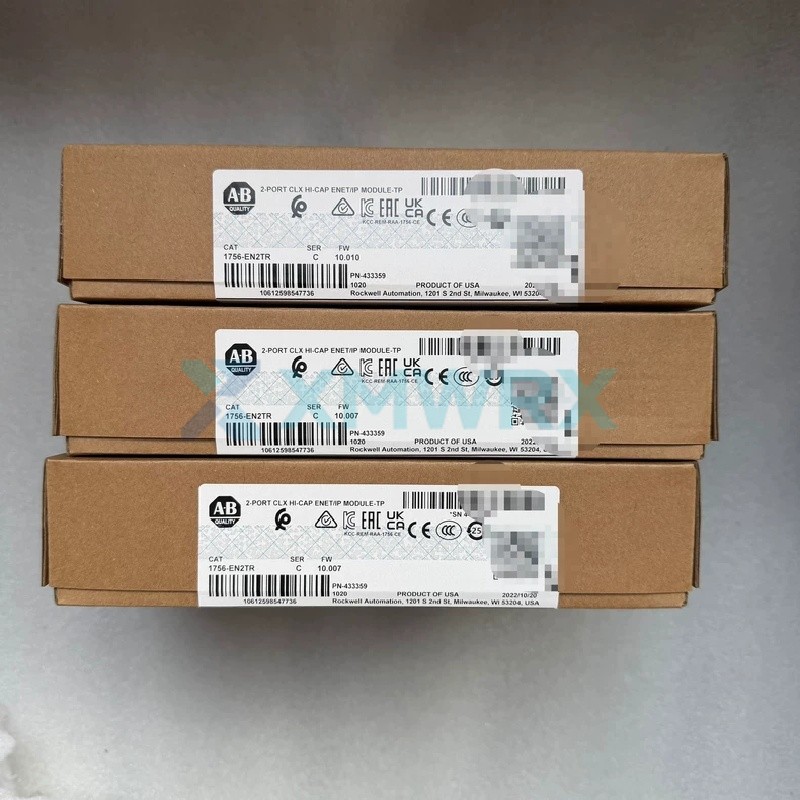
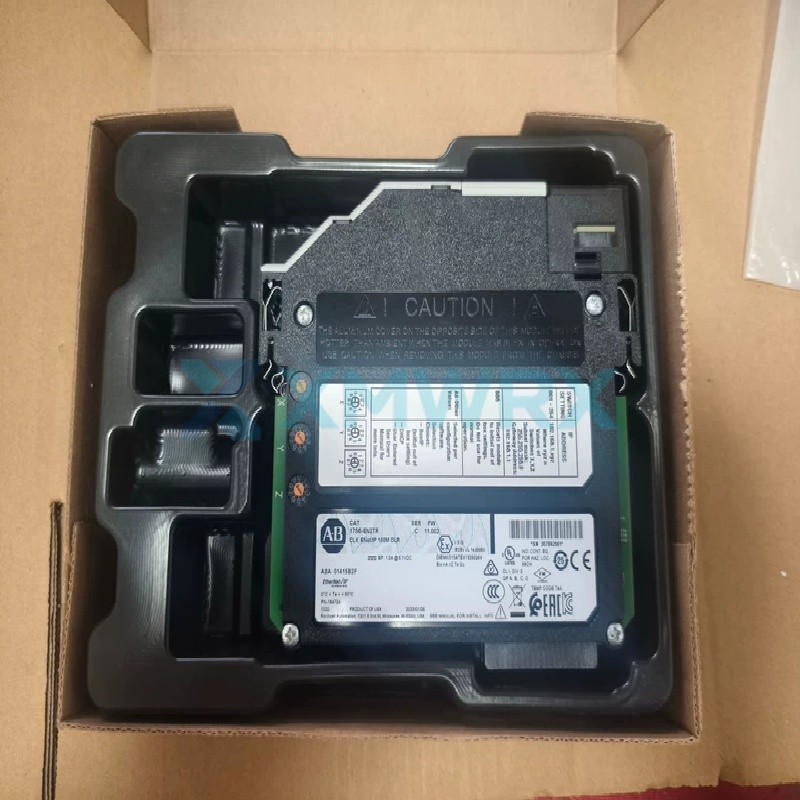
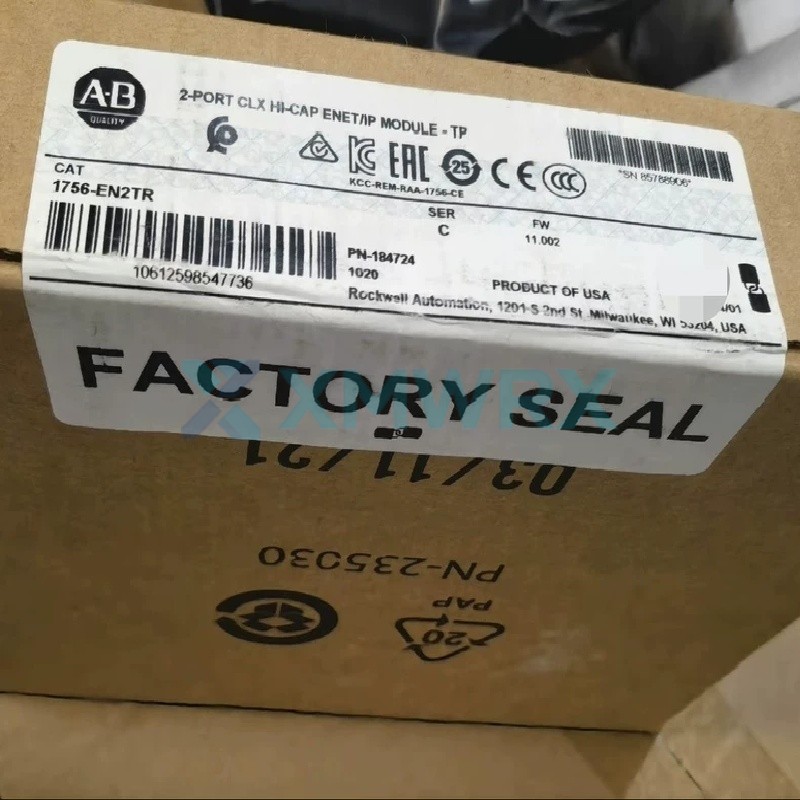
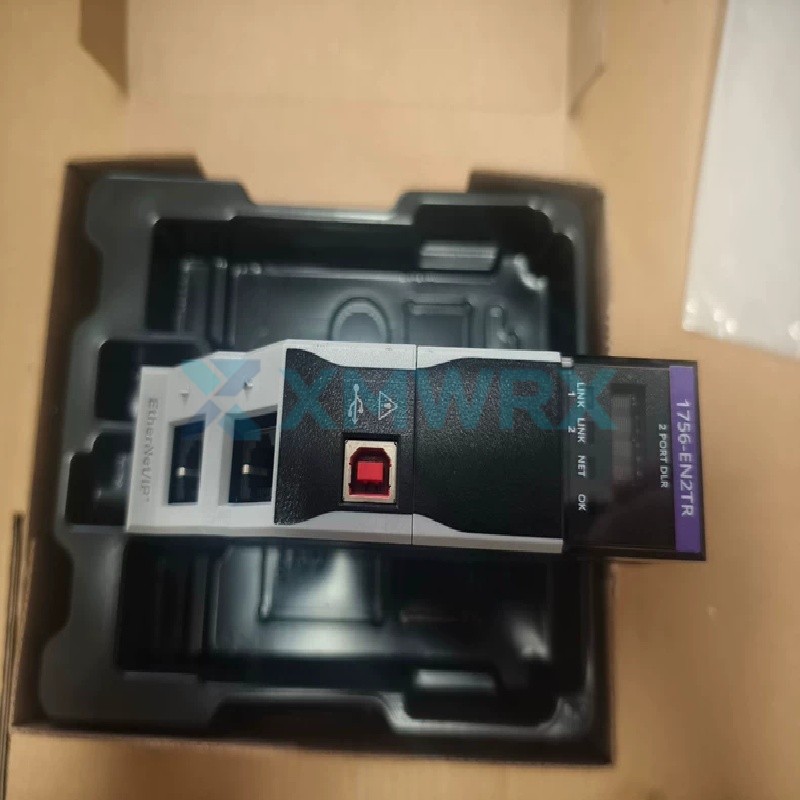
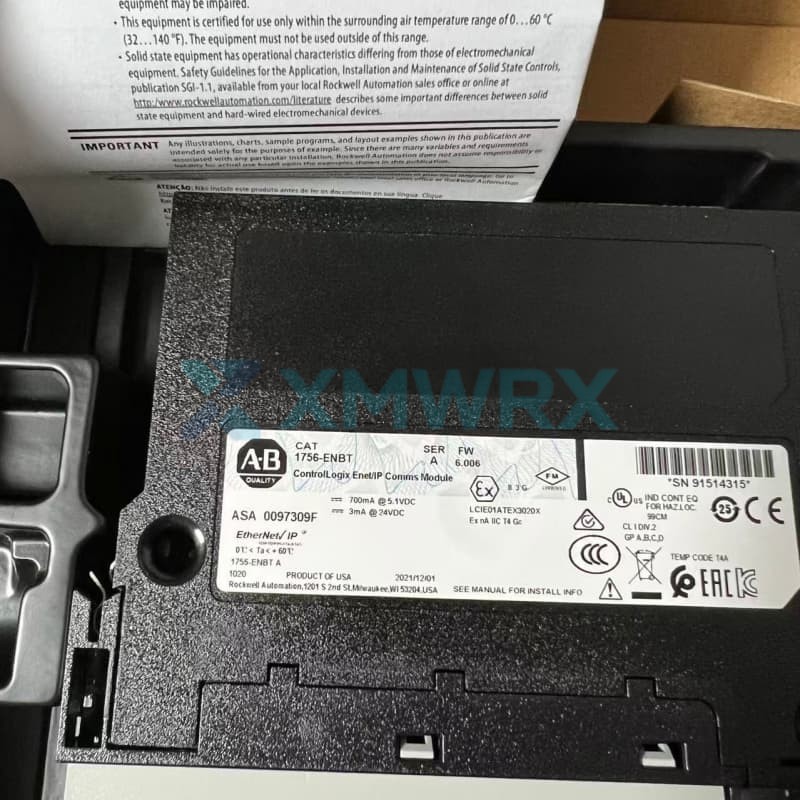
The 1756-EN2TR is a high-performance EtherNet/IP bridging module from the Allen-Bradley ControlLogix series at Rockwell Automation.
It serves as the communication interface between the ControlLogix system and the EtherNet/IP network, providing high-speed data exchange capabilities for controllers, I/O, and HMI devices. The module's most notable feature is its dual-port design, supporting device-level ring network (DLR) topologies for network redundancy and rapid recovery.
100% Original & Authentic In-Stock & Fast Shipping Expert Technical Support 12-Month Warranty
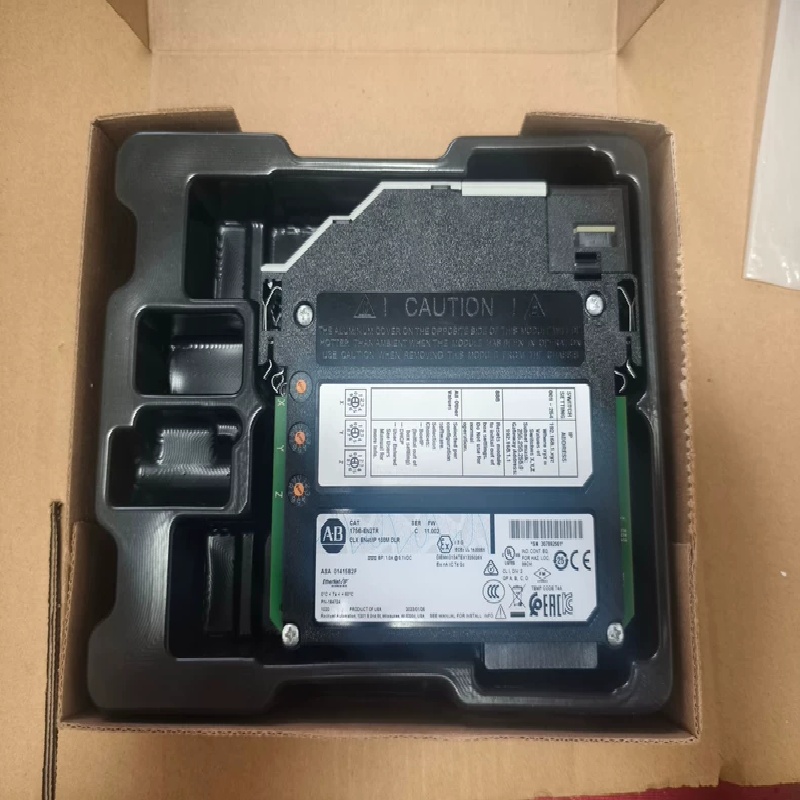
Core Features
- ✓ Dual Ethernet Ports: Equipped with two RJ45 ports, supporting 10/100 Mbps communication rates and DLR ring network redundancy, enabling microsecond-level network recovery in case of single-point failure.
- ✓ High-Performance Communication: Doubles the capacity compared to the 1756-ENBT, supporting 256 CIP connections and 128 TCP connections, enabling I/O control, message passing, and producer/consumer tagging.
- ✓ Easy Configuration: Features a USB port for PC access configuration, and a top DIP switch for quick IP address setup, simplifying module replacement.
- ✓ Wide Compatibility: Can be used as part of a gateway series, routing messages between EtherNet/IP and other NetLinx networks (such as ControlNet and DeviceNet) without controller intervention.
Technical Specifications
| Brand |
Allen Bradley
|
| Model / Part Number |
1756-EN2TR |
| Communication Ports |
2 RJ45 (twisted pair copper cable) + 1 USB 1.1 |
| Communication Rate |
10/100 Mbps, half/full-duplex auto-sensing |
| Network Topology |
Supports DLR ring, star, and linear topologies |
| CIP Connections |
256 (can be used for explicit or implicit messages) |
| TCP Connections |
128 |
| Current Consumption |
1A @ 5.1V DC; 3mA @ 24V DC |
| Power Consumption |
5.1 W |
| Heat Dissipation |
17.4 BTU/hour |
| Operating Temperature |
0°C to +60°C (32°F to +140°F) |
| Mounting Method |
ControlLogix rack, occupying 1 slot |
| Dimensions (HxWxD) |
Approx. 5.46 x 3.30 x 2.33 cm |
Frequently Asked Questions
Q: What are the practical benefits of the dual-port DLR ring network function of the 1756-EN2TR? How to configure redundancy?
A: DLR (Device-Level Ring Network) is a key technology for network redundancy. In a ring network topology, two ports are connected to form a closed loop. If any point on the ring is disconnected (e.g., due to cable damage or power failure), network communication can be automatically restored within microseconds without interrupting control. During configuration, a device needs to be selected as the ring network supervisor, and the others are ring network nodes. It's important to note that in a redundant control system (master/standby controller), the two EN2TR modules will use the same IP address. The selection of the DLR activity manager is based on the smaller MAC address, not on which is the master controller; this is often misunderstood.
Q: What are the main differences between the 1756-EN2TR and 1756-ENBT? Which one should I choose?
A: The core differences lie in performance and capacity. The 1756-EN2TR is an upgraded version of ENBT, offering double the capacity (EN2TR supports 256 CIP connections, ENBT supports 128) and dual-port DLR support (ENBT only has a single port and does not support ring network redundancy). For new projects, the 1756-EN2TR is strongly recommended; if your existing system uses ENBT and its functionality is sufficient, you can keep the original model.
Q: In which racks can the 1756-EN2TR be installed? Is it compatible with my existing ControlLogix system?
A: Excellent compatibility. This module occupies one slot and can be installed in any standard ControlLogix 1756 series rack (including the 1756-A17, A13, A10, A7, A4, etc. mentioned earlier). It can work with ControlLogix controllers (such as the 1756-L81E), I/O modules, and other communication modules in the rack, exchanging data via the backplane bus. There are no slot position restrictions during installation; it can be flexibly placed according to the system design.
Why Partner With Us?
100% Original
Genuine spare parts through rigorous supply chain control.
Quick Shipping
Expedited delivery through our global logistics network.
24/7 Support
Uninterrupted technical assistance for system installation.
Large Stock
Immediate availability from our massive control systems inventory.
leave a message
If you are interested in our products and want to know more details,please leave a message here,we will reply you as soon as we can.
 English





 IPv6 network supported